
What wears out, why and in what order it matters
A mechanical press is a machine of repetitive impact. Cada golpe transmite fuerzas que pueden ir de unas pocas toneladas a varios centenares, multiplicadas por millones de ciclos a lo largo de la vida de la máquina. Ese impacto sostenido produce un desgaste que no es un fallo — es física. El objetivo del mantenimiento no es eliminar el desgaste, sino mantenerlo dentro de límites conocidos para que nunca sorprenda.
The five systems with the highest wear criticality in an eccentric mechanical press are: crankshaft bearings and bushings, slide guides, the brake-clutch assembly, the lubrication system itself, and — in variable-stroke presses — the stroke adjustment assembly.
Crankshaft bearings and bushings
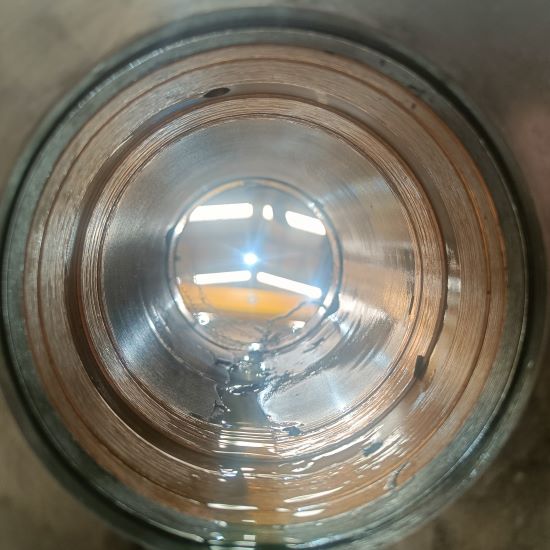
The crankshaft converts the flywheel rotation into the reciprocating motion of the slide. It rotates on bearings or bushings, normally bronze, that support the combined bending, compression and fatigue stresses of each stroke. When lubrication fails or the press systematically works near its tonnage limit, these supports are the first to deteriorate. Wear begins as a dull noise or abnormal vibration and manifests as lateral or axial movement of the crankshaft
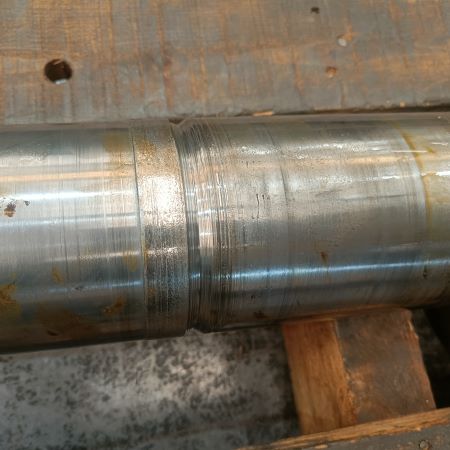
Slide guides
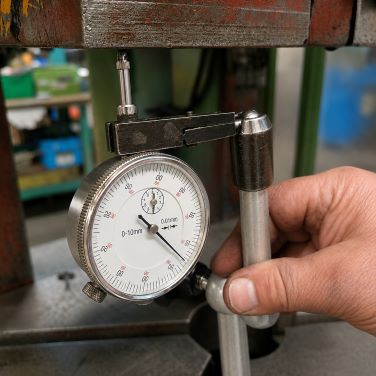
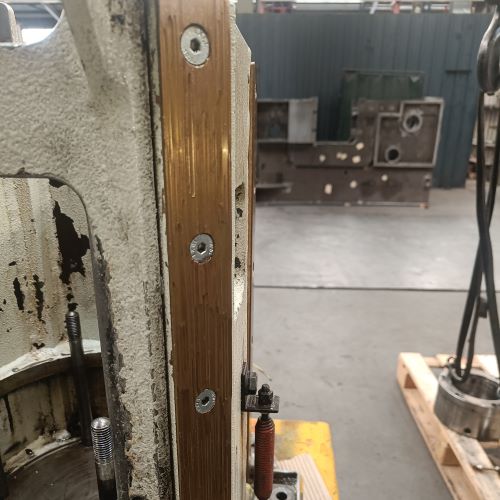
The guides keep the slide aligned with the bolster. The clearance between the slide and its guides is the most technically relevant parameter for the precision of the parts produced. When that clearance exceeds the manufacturer's limits, the die begins to receive eccentric loads: parts emerge with burrs or out of tolerance, and the die — which may be the most costly asset associated with the press — wears rapidly and asymmetrically. The serious aspect is that this process is silent. Many workshops only detect it when quality control rejects an entire batch.
As a tolerance reference: in gap frame presses with flat guides, the clearance of each individual guide should be between 0.03 and 0.05 mm. In presses working hot, slightly larger clearances are acceptable, and the tolerance increases with press size. There is also a direct relationship between guide clearance and ram parallelism: if the slide has shifted 0.25 mm out of parallel, the guide measurement will show approximately the same clearance. When guides heat up quickly on adjustment, this may be due to poor adjustment or a heavily off-centre die load; if they seize, they will require grinding or replacement, not just adjustment.
Brake-clutch assembly
The friction linings of the pneumatic brake-clutch assembly wear with every start and stop cycle. As they wear, the stopping distance increases and the slide stopping time lengthens — which can invalidate the safety distances calculated for the protection systems, with consequences that go beyond the mechanical.
The most common clutch type in modern presses is the combined low-inertia dry clutch-brake assembly. In continuous operation the friction linings can last approximately ten years; in single-stroke operation wear is greater and, depending on the type of work — tonnage, stroke frequency, number of shifts — they may need replacing after two to four years. Failing to replace linings in time leads to damage to the clutch friction discs or even failure of the assembly, a breakdown that multiplies the intervention cost.
The lubrication system itself
Oil is the lifeblood of a machine: sin aceite no funciona, y una mala distribución del aceite causa averías. No basta con comprobar el nivel del depósito — hay que verificar la presión de la bomba, que cada punto de engrase recibe la cantidad adecuada, la limpieza del aceite, del depósito y del filtro. Es la parte más vital de cualquier programa de mantenimiento.
The stroke adjustment assembly
In variable-stroke presses, the stroke adjustment mechanism connects the eccentric crankshaft con la biela mediante chaveta, acoplamiento octogonal o dentado. Esta unión soporta, en cada golpe, la totalidad de la fuerza de trabajo de la prensa. Cuando el troquel incorpora muelles de expulsión, cilindros de gas o se trabaja sobre cojín hidráulico, el conjunto también absorbe el rebote al corte (snap-through) — un pico de carga inversa que se produce en la fracción de segundo posterior a la rotura del material.
This continuous back-and-forth movement, cycle after cycle over years, generates progressive clearances in the joint. The effect on work precision depends directly on the type of operation. In cutting or punching on thick sheet, moderate clearance in the stroke adjustment rarely has any visible impact on the part. In stamping — especially on thin sheet where tolerances are tight — that same clearance can determine whether a part is acceptable or not: the slight uncontrolled movement of the crankshaft at the moment of forming translates into thickness variation, irregular deformation or out-of-tolerance results.
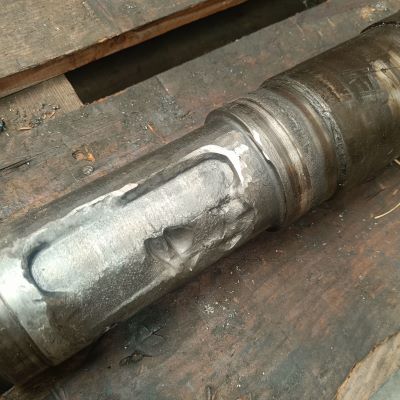
A diferencia de las guías o las guarniciones del embrague, la holgura en el cambio de carrera no puede ajustarse durante el funcionamiento normal de la prensa. Cuando supera el límite admisible, la única solución es una parada programada para desmontar el conjunto, rectificar o sustituir los componentes afectados, y volver a montarlo con los ajustes correctos. La clave del mantenimiento aquí no es la corrección — es la detección anticipada: medir la holgura periódicamente para conocer la tendencia de desgaste y planificar esa parada cuando mejor conviene al programa de producción, en lugar de esperar a que el problema se manifieste como avería mayor o rechazo de piezas.
| Componente | Early warning indicator | Consequence if not addressed | Criticidad |
|---|---|---|---|
| Crankshaft bearings | Elevated temperature, dull noise, vibration | Crankshaft seizure — catastrophic failure | Very high |
| Slide guides | Measured clearance out of tolerance, parts with burrs | Loss of precision, die damage | High |
| Guarniciones freno-embrague | Increased stopping distance, friction dust, smell | Stopping time out of specification — clutch deterioration or failure | High |
| Stroke adjustment (variable presses) | Knocking when load reverses, dimensional variation in parts, increasing measured clearance | Parts out of tolerance in stamping — major failure if ignored | Medium-high |
| Flywheel bearings | Continuous noise when running unloaded | Bearing failure — housing wear | Medium |
| Connecting rod bronze bush | Knocking every cycle, excessive clearance | Dimensional imprecision, eccentric load | Medium-high |
| Lubrication system | Distributor with no visible signal, degraded oil | Cascade failure of bearings, guides… | High |
| Criticality: potential impact if wear is not detected in time y se produce el fallo completo del componente. | |||
The working cycle affects wear
A common mistake in press maintenance management is applying the same inspection schedule regardless of how the machine works. The working mode and type of material processed determine where wear concentrates and how fast it advances.
En trabajo golpe a golpe, el sistema freno-embrague realiza un ciclo completo de embragado y frenado por cada pieza producida. Si la prensa produce 7.000 piezas por turno, las guarniciones han trabajado 7.000 veces. Las normas técnicas internacionales lo reconocen: la frecuencia de revisión del embrague debe ajustarse al número real de aplicaciones, no solo al tiempo transcurrido en el calendario.
En trabajo automático, el freno-embrague solo interviene al inicio y al final del lote. Pero aparece otro factor: el calor acumulado. El aceite del circuito de lubricación se calienta progresivamente durante producciones largas. Cuando supera su temperatura de trabajo, pierde viscosidad, la película lubricante en los cojinetes del cigüeñal se adelgaza y la protección disminuye. Una prensa que trabaja en automático durante horas necesita un sistema de lubricación en condiciones perfectas, no solo en condiciones aceptables.
El tipo de material y operación también pesa. Punching thin sheet is the most forgiving work for the press. El corte de chapa gruesa o materiales de alta resistencia genera picos de carga elevados y el fenómeno de snap-through o rebote al corte, que daña los rodamientos del volante y los casquillos de la biela de forma acumulativa. Un troquel progresivo de muchas estaciones no tolera la misma holgura en las guías que un troquel simple de corte.
The manufacturer's manual specifies the maximum tonnage, la energía máxima por golpe y la velocidad máxima para cada configuración. Trabajar habitualmente por encima del 70–75% de la capacidad nominal acelera el desgaste de forma no lineal y acorta la vida útil de los componentes críticos de manera que ningún plan de mantenimiento puede compensar por completo.
Lubrication: the main cause of serious breakdowns
Most serious breakdowns in mechanical presses originate, directly or indirectly, from a lubrication failure. Not always from absent lubrication — also from incorrect, degraded, contaminated lubrication or lubrication that simply does not reach where it needs to.
Lubrication in a press fulfils two distinct functions: in the crankshaft bearings it creates a hydrodynamic pressure film that physically separates the crankshaft from the bushing; in guides, connecting rods and joints it reduces sliding abrasion. If the first function fails — through inadequate viscosity, excessive temperature or insufficient pressure — metal-to-metal contact destroys the bearings within minutes. The standard oil change interval in recirculation systems is 2,000 working hours, or sooner if visual or laboratory analysis indicates.
Leaks — of oil and air — are more serious than they appear at first sight a simple vista. Una gota de aceite que cae cada 30 segundos supone pérdidas de unos 4 litros al mes: suficiente para vaciar progresivamente un circuito de lubricación sin que nadie lo note si no se comprueba el nivel regularmente. En el circuito neumático del embrague, la regla práctica es: si el depósito de aire pierde más de 0,7 bar por minuto con el suministro cortado, existe una fuga que debe corregirse antes de que afecte al tiempo de frenado.
The most common errors we find when carrying out repairs
- Blocked distributor without realising: el sistema centralizado funciona con normalidad aparente, pero uno o varios repartidores están bloqueados y no envían lubricante a su punto. Ese cojinete trabaja en seco hasta que falla.
- Degraded oil that nobody changes: el aceite debe cambiarse cuando ha cumplido las horas de servicio indicadas en el manual, no solo cuando el nivel baja. El aceite sucio actúa como abrasivo fino sobre las mismas superficies que debería proteger.
- Filters not replaced when changing oil: un filtro saturado retiene las partículas metálicas y genera una restricción que reduce la presión en el circuito, precisamente cuando más importa.
- Neglected rotary coupling: el racor rotativo del cigüeñal requiere engrase periódico independiente. En nuestra checklist de mantenimiento es uno de los puntos que revisamos en cada intervención precisamente porque se olvida con facilidad.
The temperature of the crankshaft bearings is the most direct indicator of lubrication condition. Si sube de forma progresiva semana a semana, hay daño produciéndose en tiempo real. Un termómetro infrarrojo cuesta menos de 30 euros. Rectificar o sustituir un cigüeñal dañado cuesta entre 50 y 100 veces más.
Detecting wear before it causes a breakdown
Preventive maintenance is more cost-effective than corrective. Industry studies quantify this: el mantenimiento de emergencia cuesta entre 3 y 5 veces más que el mismo trabajo realizado de forma programada. La diferencia la generan el trabajo urgente fuera de horario, el material defectuoso durante el fallo, la parada no planificada y, en muchos casos, los daños secundarios por efecto en cascada.
For a periodic inspection to be genuinely informative, the measured values must always be compared with previous measurements of that same press — not just with the manufacturer's limits. Building a simple histogram with successive measurements of guide clearance, bearing temperature and stopping distance allows the real rate of wear to be seen and predicts when the tolerance limit will be reached. Without this history, a clearance of 0.06 mm may appear acceptable; with it, it may be the signal that the limit will be exceeded in two months if the wear rate continues.
Los parámetros que conviene medir y registrar periódicamente son:
- Slide guide clearance — con reloj comparador apoyado en la corredera. El valor de la última medición solo tiene sentido si se compara con el de la anterior: lo que importa es la tendencia, no el dato aislado.
- Clutch stopping distance — el ángulo de parada de la corredera debe ser estable. Si aumenta semana a semana, las guarniciones están desgastadas o la presión de aire es excesiva.
- Crankshaft bearing temperature — al inicio del turno y tras dos horas de trabajo continuo. Cualquier tendencia al alza es una señal de alerta.
- Lubrication oil condition — color, turbidez y presencia de partículas metálicas. Un aceite oscuro y turbio indica contaminación activa o desgaste en curso.
- Stroke adjustment and connecting rod bearing clearance — en prensas de carrera variable, medir periódicamente la holgura en el conjunto de cambio de carrera es la única forma de anticiparse a un problema que no puede corregirse sobre la marcha. La medición en sí es sencilla con reloj comparador; lo valioso es el histórico que permite ver la velocidad de desgaste y planificar la parada correctiva antes de que el problema afecte a la calidad o provoque una avería mayor.
The person who knows the press best is not the maintenance technician
It is the operator. They work with that press every day, escucha su ritmo habitual, nota cuándo la pieza sale diferente, cuándo el ruido cambia. Si algo falla, suele ser el primero en percibir las señales — mucho antes de que sean visibles para quien solo visita la máquina de forma periódica.
Pero ese conocimiento solo tiene valor si existe un canal para comunicarlo y alguien que lo escuche y registre. Al inicio de cada turno el operario debería hacerse preguntas concretas: Does the press sound the same as yesterday? Does the slide move smoothly throughout its travel? Are there any leaks in the lubrication lines? Does the clutch or motor sound strained? Are the line pressures correct? Cualquier anomalía comunicada a tiempo vale más que cualquier inspección periódica. La clave está en que la empresa haya establecido un procedimiento claro para recibirla y actuar — no para archivarla.
A clean press allows the operator and technician to quickly identify problems as they start. Oil leaks, air leaks, incipient cracks and brake friction dust are easy to see on a clean machine — and practically invisible on one that is not. Keeping the press clean is not an aesthetic matter: es la primera medida de diagnóstico preventivo.
Documenting maintenance: mandatory and cost-effective
There is a pattern that repeats itself far too often: when a press fails seriously and the maintenance history is requested, it does not exist, is incomplete, or is in the memory of someone who no longer works at the company. Es en ese momento cuando el valor del registro se hace evidente — a destiempo.
A well-kept record contributes at three levels:
- Technical: los valores medidos en cada visita solo tienen sentido si se comparan con los anteriores. Sin historial, cada inspección empieza desde cero y es imposible detectar tendencias de desgaste antes de que lleguen al límite.
- Legal: en España, Francia y el Reino Unido el registro de intervenciones en prensas mecánicas es legalmente obligatorio y debe estar disponible para la Inspección de Trabajo, los servicios de prevención y los representantes de los trabajadores. Un registro inexistente o desactualizado agrava significativamente la posición del empresario ante un accidente o una inspección.
- Economic: las empresas que documentan su mantenimiento pueden planificar sus paradas en períodos de menor carga, en lugar de verse obligadas a reaccionar a una avería en mitad de una campaña de producción.
The format does not need to be sophisticated. Fecha, parámetros medidos, acciones realizadas, observaciones del operario y firma del responsable. Lo que importa es que exista, que sea coherente y que se consulte cuando se toma una decisión sobre la máquina.
The manufacturer's manual: why it exists and why it is ignored
The manual contains the manufacturer's technical knowledge about that specific machine: the clearance tolerances for that design, the lubricants specified for its bearing materials, the inspection intervals calibrated for that mechanism, and the correct reset instructions after an intervention. It contains information that cannot be found anywhere else.
Manuals are routinely ignored for three reasons: they cannot be found, their recommendations are considered excessively conservative ("we've been doing this for twenty years and never done what it says"), or there is no system to apply them. All three are real mistakes with real consequences.
Cliente: «No me funciona bien el sistema de elevación de la prensa.» The press arrives at the workshop. Upon inspection: el husillo no es de nuestra fabricación, el paso de rosca cambia a mitad de recorrido, la corona de elevación no está templada por inducción. Result: strip out everything done by the "trusted workshop", fabricar las piezas correctas, volver a montar. Doble gasto de dinero y tiempo.
Press parts are not generic components. Cada componente tiene una especificación de material, tratamiento y geometría que determina su comportamiento bajo carga dinámica. Un repuesto aparentemente válido puede fallar en las primeras horas o degradar silenciosamente la precisión de la máquina.
The cost of not maintaining a press correctly
The cost of poor maintenance is rarely calculated correctly porque la factura más visible — la reparación — no es la más grande. Los costes reales tienen varias capas:
Emergency repair
Replacing a seized crankshaft or guides worn beyond their limit is between 3 and 5 times more expensive than the same work carried out on a planned basis. An unexpected breakdown combines urgent work, difficulty finding stock parts for older machines, and longer execution times since the repair was not scheduled — you are not the only customer with a stopped press, and nobody will drop everything they are doing to attend to you.
Unplanned downtime
A company operating with just-in-time delivery commitments cannot tell its customer that the press has broken down. The consequences include contractual penalties, urgent shipments at costs that can triple the ordinary freight, and reputational damage with the customer.
Rejected material
A press with worn guides produces out-of-tolerance parts. If the problem is detected by the customer, the cost adds claim management and the possible return of the entire batch.
Die damage
When a press operates with excessive guide clearances, the die receives eccentric loads for which it was not designed. Guide pillars wear rapidly and in extreme cases punch breakage occurs. Repairing or replacing a progressive die can easily cost between €5,000 and €50,000.
La recomendación que damos a cualquier empresa que opera prensas mecánicas es la misma: estamos a su disposición. Llámenos, planifique sus revisiones, deje hueco en el programa para las reparaciones necesarias que indiquen nuestros técnicos. No espere a la inevitable avería.
Frequently asked questions
The components with highest wear are the crankshaft bearings and bushings, las guías de la corredera, las guarniciones del freno-embrague neumático, el sistema de lubricación y — en las prensas de carrera variable — el conjunto de cambio de carrera. En operaciones de estampación de chapa fina, este último puede ser determinante para la validez de la pieza: la holgura acumulada en la unión con el cigüeñal se traduce en variación dimensional que no puede corregirse en caliente, solo planificando una parada para desmontaje y ajuste. La velocidad de desgaste de todos ellos depende del ciclo de trabajo, el material procesado, la correcta lubricación y la regularidad del mantenimiento.
Yes. Single-stroke operation subjects the brake-clutch a un ciclo completo por cada pieza producida, generando mayor desgaste de guarniciones por unidad producida. El trabajo en automático produce un desgaste más uniforme pero acumula calor en el aceite durante producciones largas, lo que exige un sistema de lubricación en perfectas condiciones. Las normas técnicas indican que la frecuencia de revisión del embrague debe ajustarse al número real de aplicaciones, no solo al tiempo transcurrido.
It is the main cause of serious breakdowns. Los errores más frecuentes no son la ausencia total de aceite, sino distribuidor obstruido sin detectarlo, aceite degradado que nadie cambia según las horas de trabajo, o filtros sin renovar. La temperatura de los cojinetes del cigüeñal — fácil de medir con una pistola infrarroja — es el mejor indicador del estado real de la lubricación.
New noises or change in sound pattern; temperatura elevada en cojinetes, freno o embrague; piezas fuera de tolerancia o con rebabas; mayor recorrido de frenado; vibración en el bastidor; fugas de aceite visibles; consumo de aire irregular. Ninguna de estas señales debe ignorarse: siempre indican un problema que será más caro cuanto más tarde se atienda.
In Spain, France and the United Kingdom, the record of press interventions is legally mandatory y debe estar disponible para la Inspección de Trabajo. Más allá de la obligación legal, el registro es la única herramienta que permite detectar tendencias de desgaste y planificar las paradas con antelación — en lugar de reaccionar a averías imprevistas en los peores momentos.
¿Cuándo fue el último mantenimiento?
Si no lo recuerda con precisión, probablemente sea el momento. Realizamos revisiones completas con informe documentado de todos los parámetros clave y plan de actuación. Llevamos más de 70 años con estas máquinas.
Related articles
Legal status of mechanical clutch (key-type) presses
Machinery Directive, EN 692 and employer responsibilities.
Read article
Press retrofitting: when it makes sense versus buying new
Technical and economic analysis of retrofitting with pneumatic clutch.
Read article
Press safety compliance: what it requires and consequences of non-compliance
Minimum safety requirements and consequences of non-compliance.
Read articleSources and references
- Tom Flogel & George Schreck, Komatsu America — "Measuring and Troubleshooting Press Clearances", MetalForming magazine, December 2001. (Tolerancias de guías; cuantificación de fugas; tiempo de parada.)
- Michael Olle Jr., Press Service Inc. — "Care Your Equipment", Metalforming / PMA, 2006. (Sistemas de lubricación; errores frecuentes en campo.)
- James A. Szumera — The Metal Stamping Process, citado en Metalforming / PMA. (Role of the operator in preventive maintenance.)
- HSE — Health and Safety Executive (UK) — Safe use of power presses, HSG236, 2.ª ed., 2003. (Periodic inspection framework; registro obligatorio; caso real de mantenimiento documentado.)
- David A. Smith — Fundamentals of Pressworking, cap. 10: «Press Inspection and Maintenance», Society of Manufacturing Engineers (SME), 1994. (Procedimientos de medición; análisis de fallos; lubricación en prensas de gran tonelaje.)
- INRS — Institut National de Recherche et de Sécurité (Francia) — ED 781: Presses mécaniques — Vérifications, 3.ª ed., 2011. (European regulatory frameworks; inspection frequencies.)