
What wears, why, and why the order matters
A mechanical press is a repetitive-impact machine. Every stroke transmits forces ranging from a few tonnes to several hundred, multiplied by millions of cycles over the machine's life. That sustained impact produces wear that is not a fault — it is physics. The goal of maintenance is not to eliminate wear, but to keep it within known limits so that it never comes as a surprise.
The five most wear-critical systems on an eccentric mechanical press are: the crankshaft bearings and bushings, the slide guides, the brake-clutch assembly, the lubrication system itself, and — on variable-stroke presses — the stroke-change assembly.
Crankshaft bearings and bushings
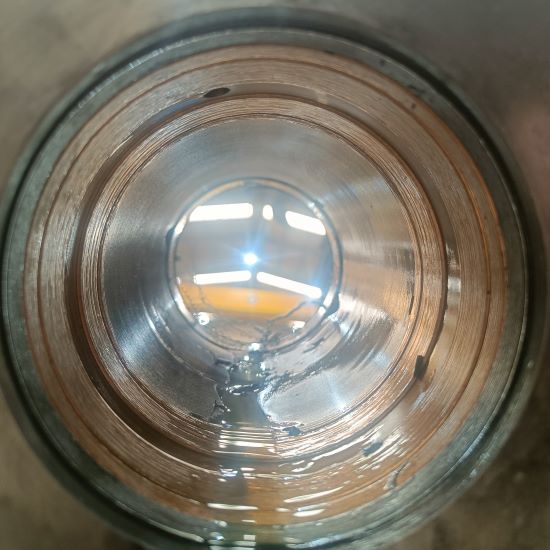
The crankshaft converts the flywheel's rotation into the reciprocating motion of the slide. It turns on bearings or bushings, usually of bronze, that carry the combined bending, compression and fatigue loads of every stroke. When lubrication fails or the press systematically works close to its tonnage limit, these supports are the first to deteriorate. The wear begins as a dull noise or abnormal vibration and shows up as lateral or axial movement of the crankshaft.
Slide guides
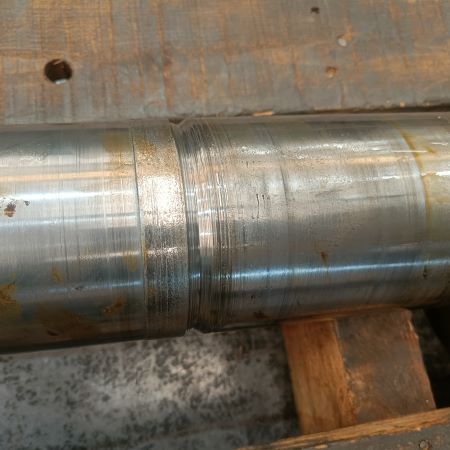
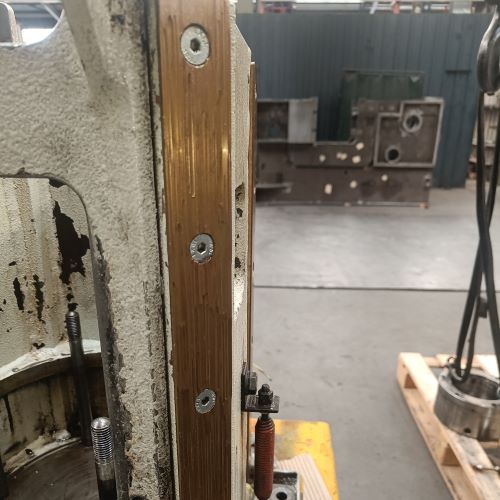
The guides keep the slide aligned with the bed. The clearance between the slide and its guides is the single most relevant technical parameter for the accuracy of the parts produced. When that clearance exceeds the manufacturer's limits, the die begins to take eccentric loads: parts come out with burrs or out of tolerance, and the die — potentially the most expensive asset associated with the press — wears in an accelerated, asymmetric way. The serious part is that this process is silent. Many shops only detect it when quality control rejects a whole batch.
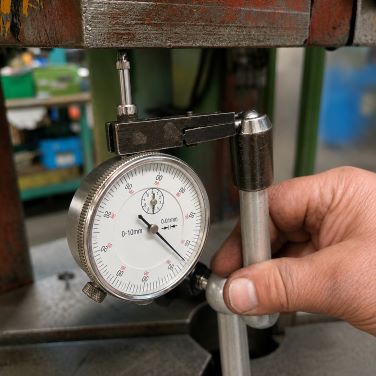
As a tolerance reference: on C-frame presses with flat guides, the clearance of each individual guide should be between 0.03 and 0.05 mm. Presses working hot allow somewhat larger clearances, and the tolerance increases with press size. There is also a direct relationship between guide clearance and slide parallelism: if the slide has moved 0.25 mm out of parallel, the guide measurement will show roughly that same clearance. When the guides heat up quickly during adjustment, it may be due to poor adjustment or a badly offset load in the die; if they actually seize they will need regrinding or replacement, not just adjustment.
Brake-clutch system
The friction linings of the pneumatic brake-clutch assembly are consumed with every start-stop cycle. As they wear, the braking travel increases and the stopping time of the slide lengthens — which can invalidate the safety distances calculated for the guarding systems, with consequences that go beyond the mechanical.
The most common clutch type on modern presses is the combined low-inertia dry clutch-brake unit. In continuous running the linings can last about ten years; in single-stroke running the wear is higher and, depending on the type of work — tonnage, stroke frequency, number of shifts — they may need replacing after two to four years. Failing to replace the linings in time leads to damage to the clutch friction discs or even the failure of the whole unit, a breakdown that multiplies the cost of the intervention.
The lubrication system itself
Oil is a machine's lifeblood: without oil it does not run, and poor oil distribution causes breakdowns. Checking the reservoir level is not enough — you must verify the pump pressure, that each lubrication point receives the right amount, and the cleanliness of the oil, the reservoir and the filter. It is the most vital part of any maintenance programme.
The stroke-change assembly
On variable-stroke presses, the stroke-change mechanism joins the eccentric crankshaft to the connecting rod by means of a key, an octagonal coupling or splines. This joint carries the full working force of the press on every stroke. When the die incorporates ejection springs, gas cylinders or works on a hydraulic cushion, the assembly also absorbs the snap-through — a reverse load spike that occurs in the fraction of a second after the material breaks.
That continuous back-and-forth motion, cycle after cycle over years, generates progressive clearance in the joint. Its effect on working accuracy depends directly on the type of operation. In blanking or piercing of thick sheet, moderate clearance in the stroke change rarely has a visible impact on the part. In stamping — especially in thin sheet where tolerances are tight — that same clearance can determine whether a part is acceptable or not: the slight uncontrolled movement of the crankshaft at the moment of forming translates into thickness variation, irregular deformation or out-of-tolerance parts.
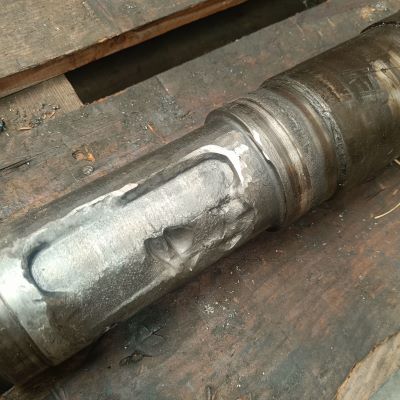
Unlike the guides or the clutch linings, clearance in the stroke change cannot be adjusted during normal press operation. When it exceeds the admissible limit, the only solution is scheduled downtime to strip the assembly, regrind or replace the affected components, and reassemble it with the correct settings. The key to maintenance here is not correction — it is early detection: measuring the clearance periodically to know the wear trend and plan that stoppage when it best suits the production schedule, instead of waiting for the problem to show up as a major breakdown or rejected parts.
| Component | Early warning indicator | Consequence if ignored | Criticality |
|---|---|---|---|
| Crankshaft bearings | High temperature, dull noise, vibration | Crankshaft seizure — catastrophic failure | Very high |
| Slide guides | Measured clearance out of tolerance, burred parts | Loss of accuracy, die damage | High |
| Brake-clutch linings | Increased braking travel, friction dust, smell | Stopping time out of spec — clutch deterioration or failure | High |
| Stroke change (variable presses) | Knock on load reversal, dimensional variation, growing measured clearance | Out-of-tolerance stamped parts — major breakdown if ignored | Medium-high |
| Flywheel bearings | Continuous noise at no-load running | Bearing failure — housing wear | Medium |
| Connecting-rod bronze | Knock on every cycle, excessive clearance | Dimensional inaccuracy, eccentric loading | Medium-high |
| Lubrication system | Distributor with no visible signal, degraded oil | Cascade failure of bearings, guides... | High |
| Criticality: potential impact if the wear is not detected in time and the component fails completely. | |||
The work cycle changes the wear
A common mistake in press maintenance management is to apply the same inspection programme regardless of how the machine works. The operating mode and the type of material processed determine where wear concentrates and how fast it advances.
In single-stroke work, the brake-clutch system performs a full engage-and-brake cycle for every part produced. If the press makes 7,000 parts per shift, the linings have worked 7,000 times. International technical standards recognise this: the clutch inspection frequency must be matched to the actual number of applications, not just to calendar time elapsed.
In automatic work, the brake-clutch only acts at the start and end of the batch. But another factor appears: accumulated heat. The lubrication oil heats up progressively during long runs. When it exceeds its working temperature it loses viscosity, the lubricating film in the crankshaft bearings thins and protection falls. A press running automatically for hours needs a lubrication system in perfect condition, not merely acceptable condition.
The type of material and operation also matters. Blanking thin sheet is the kindest work for the press. Cutting thick sheet or high-strength materials generates high load spikes and the snap-through phenomenon, which damages the flywheel bearings and connecting-rod bushings cumulatively. A multi-station progressive die will not tolerate the same guide clearance as a simple cutting die.
The manufacturer's manual states the maximum tonnage, the maximum energy per stroke and the maximum speed for each configuration. Habitually working above 70–75% of the rated capacity accelerates wear non-linearly and shortens the life of critical components in a way that no maintenance plan can fully compensate for.
Lubrication: the main cause of serious breakdowns
Most serious breakdowns on mechanical presses originate, directly or indirectly, in a lubrication failure. Not always in absent lubrication — also in lubrication that is incorrect, degraded, contaminated, or that simply does not reach where it needs to.
Lubrication on a press serves two distinct functions: in the crankshaft bearings it creates a hydrodynamic pressure film that physically separates the crankshaft from the bushing; in guides, connecting rods and joints it reduces sliding abrasion. If the first function fails — through inadequate viscosity, excessive temperature or insufficient pressure — metal-to-metal contact destroys the bearings within minutes. The usual oil-change interval in recirculating systems is 2,000 working hours, or sooner if visual or laboratory analysis so indicates.
Leaks — of oil and of air — are more serious than they look at first sight. A drop of oil falling every 30 seconds means losses of about 4 litres a month: enough to progressively empty a lubrication circuit without anyone noticing unless the level is checked regularly. In the clutch's pneumatic circuit, the rule of thumb is: if the air reservoir loses more than 0.7 bar per minute with the supply shut off, there is a leak that must be fixed before it affects the stopping time.
The most frequent errors we find when carrying out repairs
- An unknowingly blocked distributor: the centralised system runs apparently normally, but one or more metering blocks are blocked and send no lubricant to their point. That bearing runs dry until it fails.
- Degraded oil that nobody changes: the oil must be changed when it has met the service hours stated in the manual, not just when the level drops. Dirty oil acts as a fine abrasive on the very surfaces it should protect.
- Filters not renewed at the oil change: a saturated filter retains metal particles and creates a restriction that reduces circuit pressure, precisely when it matters most.
- Neglected rotary union: the crankshaft's rotary union needs its own periodic greasing. In our maintenance checklist it is one of the points we check at every intervention precisely because it is so easily forgotten.
The temperature of the crankshaft bearings is the most direct indicator of the state of lubrication. If it rises progressively week after week, damage is occurring in real time. An infrared thermometer costs less than 30 euros. Regrinding or replacing a damaged crankshaft costs between 50 and 100 times more.
Detecting wear before it causes the breakdown
Preventive maintenance is more cost-effective than corrective. Industry studies quantify it: emergency maintenance costs between 3 and 5 times more than the same work done on a planned basis. The difference comes from urgent out-of-hours work, defective material during the failure, unplanned downtime and, in many cases, secondary cascade damage.
For a periodic inspection to be genuinely informative, the measured values must always be compared with previous measurements of that same press — not only with the manufacturer's limits. Building a simple chart from successive measurements of guide clearance, bearing temperature and braking travel makes it possible to see the real rate at which wear is occurring and to predict when it will reach the tolerance limit. Without this history, a clearance of 0.06 mm may look acceptable; with it, it may be the sign that the limit will be exceeded in two months if the wear rate continues.
The parameters worth measuring and recording periodically are:
- Slide guide clearance — with a dial indicator resting on the slide. The latest reading only makes sense compared with the previous one: what matters is the trend, not the isolated figure.
- Clutch braking travel — the slide's stopping angle should be stable. If it grows week after week, the linings are worn or the air pressure is excessive.
- Crankshaft bearing temperature — at the start of the shift and after two hours of continuous work. Any upward trend is a warning sign.
- Condition of the lubrication oil — colour, turbidity and presence of metal particles. Dark, cloudy oil indicates active contamination or wear in progress.
- Stroke-change and connecting-rod bearing clearance — on variable-stroke presses, periodically measuring the clearance in the stroke-change assembly is the only way to anticipate a problem that cannot be corrected on the fly. The measurement itself is simple with a dial indicator; the valuable part is the history that reveals the wear rate and lets you plan the corrective stoppage before the problem affects quality or causes a major breakdown.
The person who knows the press best is not the maintenance technician
It is the operator. They work with that press every day, they hear its normal rhythm, they notice when the part comes out different, when the noise changes. If something goes wrong, they are usually the first to perceive the signs — long before they are visible to someone who only visits the machine periodically.
But that knowledge only has value if there is a channel to communicate it and someone to listen and record it. At the start of each shift the operator should ask concrete questions: does the press sound the same as yesterday? Does the slide move smoothly over its whole travel? Are there leaks in the lubrication lines? Does the clutch or the motor sound strained? Are the pressures in the lines correct? Any anomaly reported in time is worth more than any periodic inspection. The key is that the company has established a clear procedure to receive it and act — not to file it away.
A clean press lets the operator and the technician quickly spot problems the moment they start. Oil leaks, air leaks, incipient cracks and brake friction dust are easy to see on a clean machine — and practically invisible on one that is not. Keeping the press clean is not a matter of appearance: it is the first measure of preventive diagnosis.
Documenting maintenance: mandatory and cost-effective
There is a pattern that repeats far too often: when a press fails seriously and the maintenance history is requested, it does not exist, is incomplete, or is in the memory of someone who no longer works at the company. It is at that moment that the value of the record becomes obvious — too late.
A well-kept record delivers on three levels:
- Technical: the values measured at each visit only make sense compared with the previous ones. Without a history, every inspection starts from scratch and it is impossible to detect wear trends before they reach the limit.
- Legal: in Spain, France and the United Kingdom the record of interventions on mechanical presses is a legal requirement and must be available to the labour inspectorate, the prevention services and the workers' representatives. A non-existent or out-of-date record significantly worsens the employer's position in the event of an accident or an inspection.
- Economic: companies that document their maintenance can schedule their stoppages in lower-load periods, instead of being forced to react to a breakdown in the middle of a production run.
The format need not be sophisticated. Date, parameters measured, actions taken, operator observations and the signature of the person responsible. What matters is that it exists, that it is consistent, and that it is consulted when a decision is made about the machine.
The manufacturer's manual: why it exists and why it is ignored
The manual captures the manufacturer's technical knowledge of that particular machine: the clearance tolerances of that design, the lubricants specified for its bearing materials, the inspection intervals calibrated for that mechanism, and the instructions for correct reassembly after an intervention. It contains information that cannot be found anywhere else.
Manuals are routinely disregarded for three reasons: they cannot be found, their recommendations are considered excessively conservative ("we've done it our way for twenty years and never followed what it says"), or there is no system to apply them. All three are real mistakes with real consequences.
Customer: "The press's lifting system isn't working properly." The press arrives at the workshop. On inspection: the screw is not our manufacture, the thread pitch changes halfway along its travel, the lifting crown is not induction-hardened. Result: strip out everything the "trusted workshop" had done, make the correct parts, reassemble. Double the money and time.
Press parts are not generic parts. Each component has a material, treatment and geometry specification that determines its behaviour under dynamic load. An apparently suitable spare can fail in the first few hours or silently degrade the accuracy of the machine.
What it costs to not maintain a press properly
The cost of poor maintenance is rarely calculated correctly because the most visible bill — the repair — is not the biggest one. The real costs have several layers:
The emergency repair
Replacing a seized crankshaft or guides worn beyond the limit is between 3 and 5 times more expensive than the same work done on a planned basis. In an unforeseen breakdown, the urgent work, the difficulty of finding parts in stock for old machines, and the lead time to make them because the repair was not scheduled all coincide — you are not the only customer with a stopped press, and nobody is going to drop everything to attend to you.
The unplanned stoppage
A company working to just-in-time delivery commitments cannot tell its customer that the press has broken down. The consequences include contractual penalties, urgent shipments at costs that can triple the ordinary freight, and reputational damage with the customer.
The rejected material
A press with worn guides produces out-of-tolerance parts. If the customer detects the problem, the cost adds the handling of the complaint and the possible return of the whole batch.
The die damage
When a press works with excessive guide clearance, the die takes eccentric loads it was not designed for. The guide pillars wear at an accelerated rate and in extreme cases punches break. Repairing or replacing a progressive die can easily cost between 5,000 and 50,000 euros.
The recommendation we give any company operating mechanical presses is the same: we are here for you. Call us, plan your inspections, leave room in the schedule for the necessary repairs our technicians identify. Don't wait for the inevitable breakdown.
Frequently asked questions
The components that wear most are the crankshaft bearings and bushings, the slide guides, the pneumatic brake-clutch linings, the lubrication system and — on variable-stroke presses — the stroke-change assembly. In thin-sheet stamping the latter can decide whether a part is acceptable: the clearance accumulated at the joint with the crankshaft translates into dimensional variation that cannot be corrected while running, only by planning downtime for stripping and adjustment. The wear rate of them all depends on the work cycle, the material processed, correct lubrication and regular maintenance.
Yes. Single-stroke work subjects the brake-clutch to a full cycle for every part produced, causing greater lining wear per unit produced. Automatic work produces more uniform wear but accumulates heat in the oil during long runs, which demands a lubrication system in perfect condition. Technical standards indicate that clutch inspection frequency must be matched to the actual number of applications, not just to elapsed time.
It is the leading cause of serious breakdowns. The most frequent errors are not a total absence of oil, but an undetected blocked distributor, degraded oil that nobody changes according to working hours, or filters left unrenewed. The crankshaft bearing temperature — easy to measure with an infrared gun — is the best indicator of the real state of lubrication.
New noises or a change in the sound pattern; high temperature in bearings, brake or clutch; parts out of tolerance or with burrs; increased braking travel; frame vibration; visible oil leaks; irregular air consumption. None of these signs should be ignored: they always point to a problem that will be more expensive the later it is attended to.
In Spain, France and the United Kingdom the record of interventions on presses is a legal requirement and must be available to the labour inspectorate. Beyond the legal duty, the record is the only tool that allows wear trends to be detected and stoppages to be planned in advance — rather than reacting to unforeseen breakdowns at the worst moments.
When was the last maintenance?
If you can't remember precisely, it is probably time. We carry out full inspections with a documented report of every key parameter and an action plan. We have more than 70 years with these machines.
Related articles
Legal status of mechanical (key) clutch presses
Machinery Directive, EN 692, RD 1215/97 and the employer's responsibilities.
Read article
Press retrofitting: when it makes sense versus buying new
A technical and economic analysis of retrofitting with a pneumatic clutch.
Read article
Press safety regulations: what they require and what non-compliance means
Minimum safety requirements and the consequences of not meeting them.
Read articleSources and references
- Tom Flogel & George Schreck, Komatsu America — "Measuring and Troubleshooting Press Clearances", MetalForming magazine, December 2001. (Guide tolerances; leak quantification; stopping time.)
- Michael Olle Jr., Press Service Inc. — "Care for Your Equipment", MetalForming / PMA, 2006. (Lubrication systems; common field errors.)
- James A. Szumera — The Metal Stamping Process, cited in MetalForming / PMA. (The operator's role in preventive maintenance.)
- HSE — Health and Safety Executive (UK) — Safe use of power presses, HSG236, 2nd ed., 2003. (Framework for periodic examination; mandatory record; documented-maintenance real case.)
- David A. Smith — Fundamentals of Pressworking, ch. 10: "Press Inspection and Maintenance", Society of Manufacturing Engineers (SME), 1994. (Measurement procedures; failure analysis; lubrication on large-tonnage presses.)
- INRS — Institut National de Recherche et de Sécurité (France) — ED 781: Presses mécaniques — Vérifications, 3rd ed., 2011. (European regulatory frameworks; inspection frequencies.)