
This analysis is not intended to be exhaustive or to cover every applicable regulation — aspects such as the guarding of transmission parts or pneumatic rules, among others, are left out. It focuses on the most significant points and, in particular, on the working area, which is the most dangerous. Ultimately it is the company's prevention services who must assess each specific case, and the employer who bears the primary liability, both criminal and civil.
What a mechanical clutch press is and why its danger is different
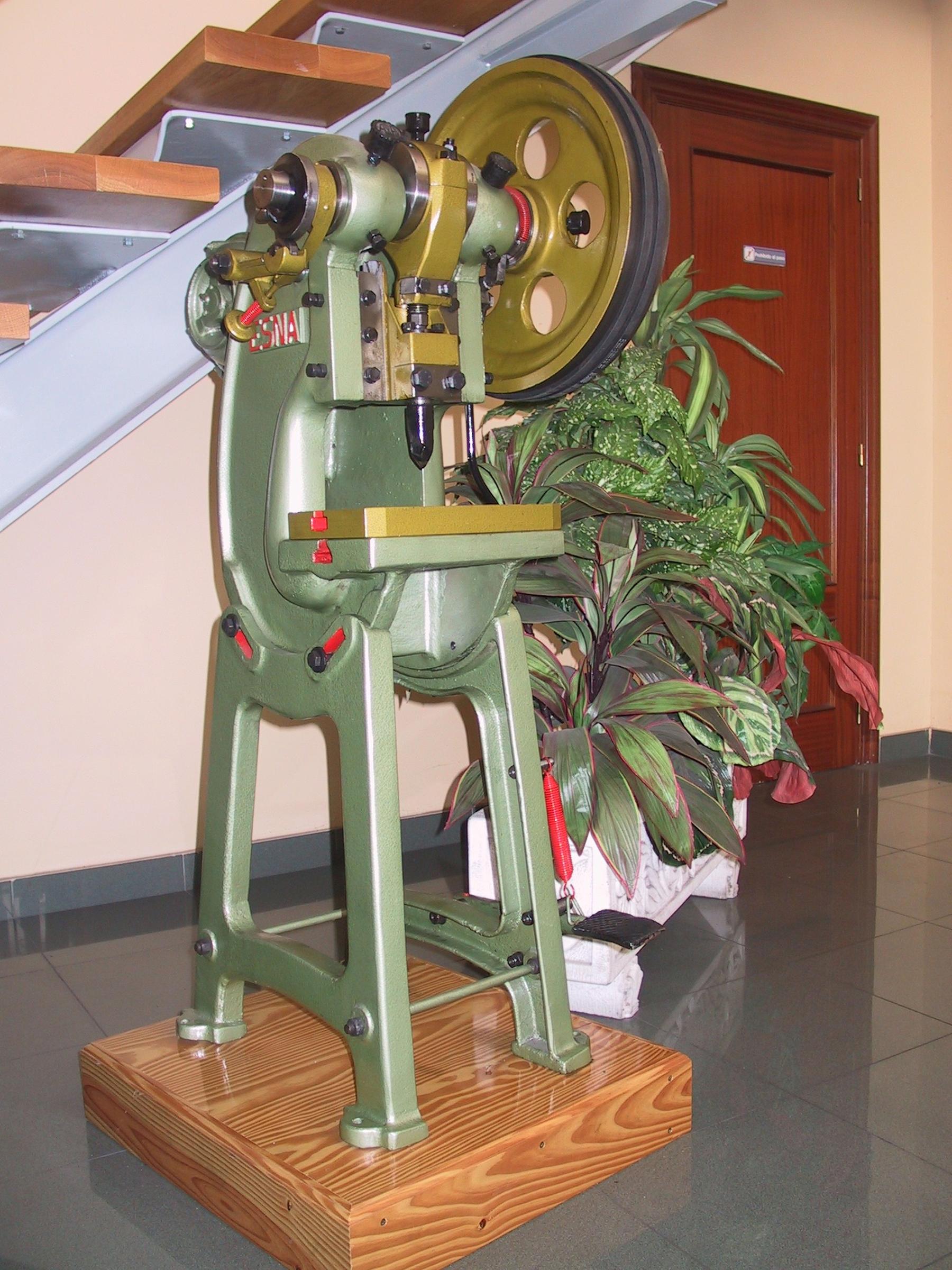
Mechanical clutch presses — also called full-revolution, positive-clutch or key clutch presses — are a type of eccentric press in which the clutch mechanism links the flywheel to the crankshaft by means of a steel key. Once the cycle starts, the press inevitably completes a full revolution until the slide returns to top dead centre (TDC). It is not possible to stop the movement mid-cycle.
This feature, which looks like a technical detail, has first-order regulatory and safety consequences: all the guarding systems common on modern presses — two-hand controls, photoelectric barriers, light curtains — rely precisely on the machine's ability to stop at any point of its stroke when an intrusion into the danger zone is detected. On a key clutch press, that is impossible by design.
This is the fundamental difference from pneumatic or friction clutch presses, which can stop at any crankshaft angle. It is also the underlying reason why European regulations have progressively restricted the use of mechanical clutch presses until it became practically unviable.
Part 1: legal status since the Machinery Directive came into force (1995)
The Machinery Directive came into force in Spain on 1 January 1995. From that date, in theory it was still possible to build new presses with a full-revolution clutch, but the conditions required made it unfeasible in practice. To understand why, it helps to know the turbulent history of how the harmonised technical standard EN 692* was drafted.
The difficult passage of EN 692
EN 692 for mechanical presses was controversial from its very first draft:
- In the first 1992 draft, Annex A set out 7 requirements for the design of the key clutch (one specific to presses above 35 t) and two to prevent inadvertent start-up.
- In draft no. 15 of March 1994, the design requirements had been cut to 5 and the tonnage-specific one now applied from 40 t.
- In prEN 692:1994 revision 1 it remained unchanged, which suggested those requirements were final — and so they were carried into EN 692:1996.
The Annex A requirements: latch design
The purpose of the standard's requirements was the design of the latch and the prevention of overtravel and inadvertent or delayed starts. Annex A (normative) set out, among others:
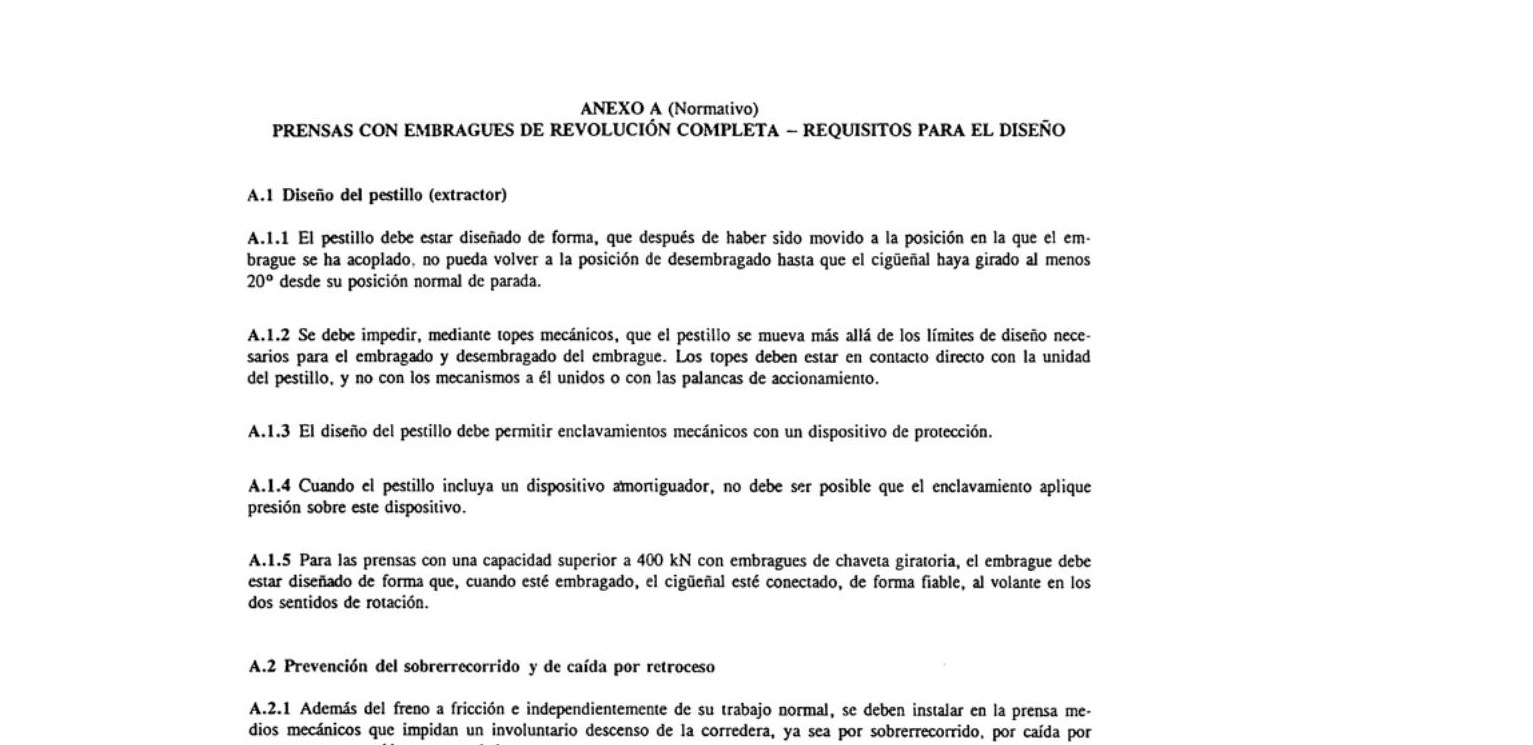
It is already clear that there is a very specific requirement affecting the latch design that can hardly be applied to presses built earlier without these aspects in mind. The traditional design of any Spanish manufacturer makes it very difficult even to meet point A.1.3 (mechanical interlocking with a guarding device).
The Annex B requirements: guards
The standard also requires mechanical means to prevent the inadvertent descent of the slide. Since a spring failure or a broken key would cause a repeat stroke, the guard must be a locking one: while the press has energy — motor running or flywheel turning with residual energy — the guard cannot open.
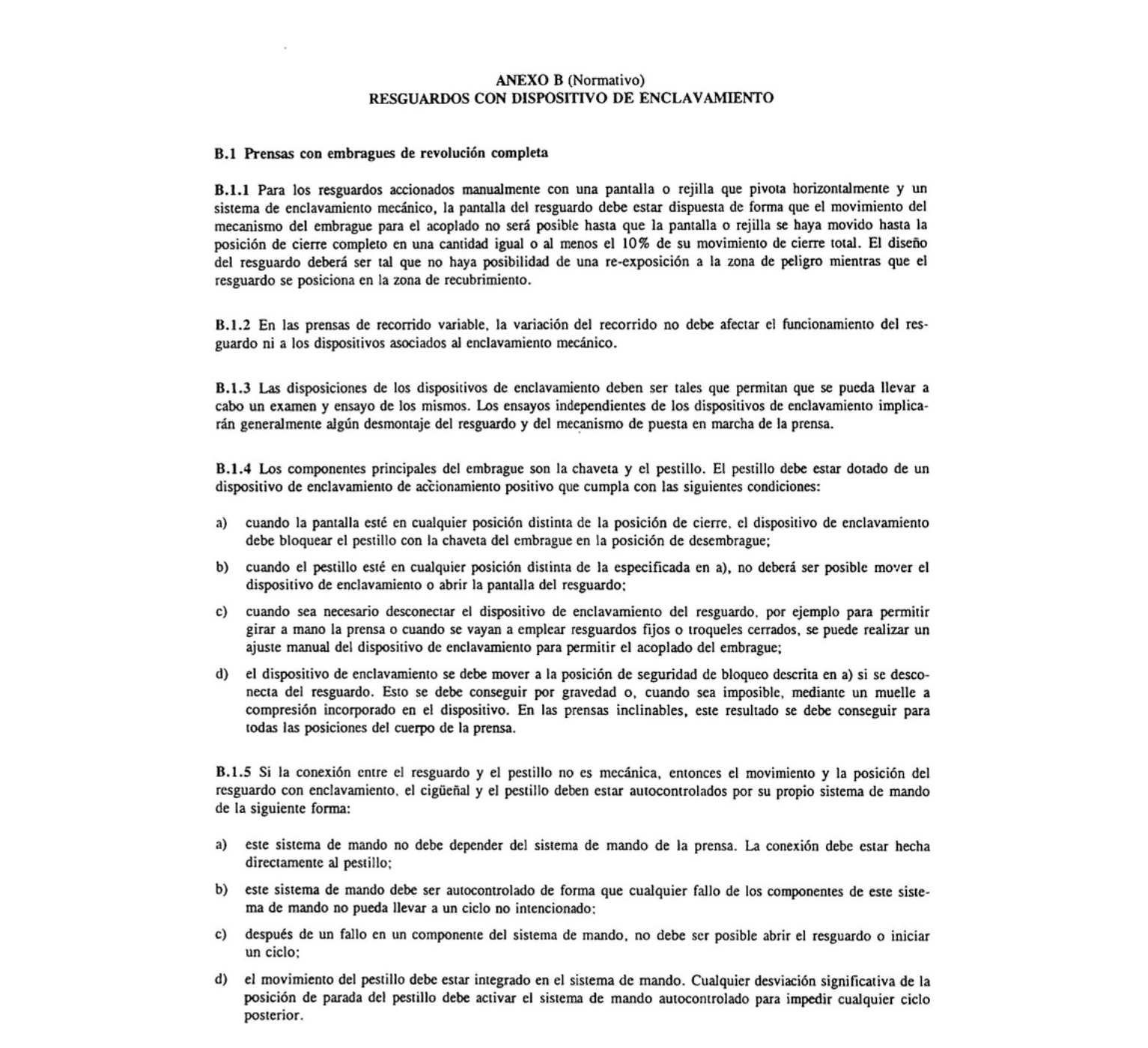
The conditions set for the mechanical connection of the guard to the latch are practically impossible to meet on any press already built. Point B.1.5 states that if the connection is not mechanical, a self-monitoring system independent of the press control is required which, after a failure, does not allow the guard to open. This leads to an electromagnetic locking system that can only open when the motor is stopped AND the flywheel has stopped turning (a flywheel-stop monitoring system).
From all the requirements it follows that the only real possibility is fully enclosed presses, with the working area closed, fixed or electromagnetically locked while any energy is present. In other words, machines exclusively for automatic work: it would not be possible to open the guard, place the part, close, trigger, cut the power, wait for the flywheel to stop and open again — the resulting productivity would be unviable.
The political reasons behind keeping them... and later removing them
It is worth asking: if their use is almost impracticable, why were they authorised? The answer is clear: they were not meant to be authorised, but eliminated, yet there were political reasons in the Machinery Committee that made this impossible. The United Kingdom's representatives demanded they be kept, under pressure from their gasket- and washer-making industries — sectors with a large fleet of these machines — which, after the early-1990s crisis, could not afford to renew them. The other countries represented, including the Spanish delegates, were opposed and sought to eliminate these machines. The result was to authorise them under use and design conditions so strict that they became practically unviable.
In the first revision of the standard — EN 692:2005 — every mention of mechanical clutch presses was removed. Since then there has been no presumption of conformity for these machines. Although between 1995 and 2005 they were theoretically authorised under very specific conditions, they now appear as a possibility under no circumstances within the harmonised standard. The Machinery Directive in force until 20 January 2027 is 2006/42/EC, which will be repealed and replaced by the new Regulation (EU) 2023/1230 — published on 29 June 2023 and mandatory from that date in every Member State.
Directive 2006/42/EC → Regulation (EU) 2023/1230. Directive 2006/42/EC continues to apply until 20 January 2027. From that date Regulation (EU) 2023/1230 takes effect, and being a European Regulation — not a directive — it applies directly in every Member State without national transposition, removing divergences of interpretation between countries. For existing mechanical clutch presses, the framework that continues to apply is RD 1215/1997, which does not change with this handover.
Part 2: legal status of the mechanical clutch presses already in companies
The situation affecting most readers is that of full-revolution clutch presses already in use in their plants — machines built before 1995, before the Machinery Directive came into force. These are covered by Royal Decree 1215/1997, which although colloquially known as the "used-machinery decree" actually sets out the minimum safety requirements applicable to all work equipment, whether new or not.
Which standard governs these presses?
To avoid personal interpretations, the official application guide for RD 1215/1997 — published by the Ministry of Industry — states clearly that machines existing before the Directive must be governed by the regulations in force at the time of their manufacture. In the specific case of presses, the guide expressly indicates that the reference standard is UNE 81-602:1986.
As a starting point, this means that presses built before 1986 will almost certainly fail to meet many of its requirements. But it should not be assumed for later ones either: that UNE standard was mired in controversy from the outset, because the law stated that press regulations would be published in a technical regulation of higher rank, which the UNE standard did not have. For this reason many manufacturers did not apply it, or applied it partially — even the Labour Inspectorate and the Industry Inspectorate could not agree at the time on which standard to require. A telling example: UNE 81-602:1986 banned band brakes, and some now-defunct manufacturers were still using them.
Specific UNE 81-602:1986 requirements for full-revolution presses
The standard sets the following specific requirements for this type of clutch:
- The keys shall be designed to withstand the stress to which they are subjected.
- The keys and their seats shall be designed to exclude self-locking (jamming, seizure, etc.).
- On positive-clutch presses, stopping shall occur at the end of the cycle (TDC — top dead centre).
- An anti-repeat device must be provided.
- This device may be disabled for continuous running.
- Disabling shall be carried out without dismantling the device.
Point-of-operation guarding: what the standard allows and forbids
As regards point-of-operation guarding, UNE 81-602:1986 provides for the following methods:
- Closed dies.
- Fixed guards.
- Movable guards specific to positive-clutch presses.
- Sweep/pull-back devices.
And it explicitly excludes — for the technical reasons already explained (the impossibility of stopping mid-cycle) — two-hand controls and photoelectric barriers.
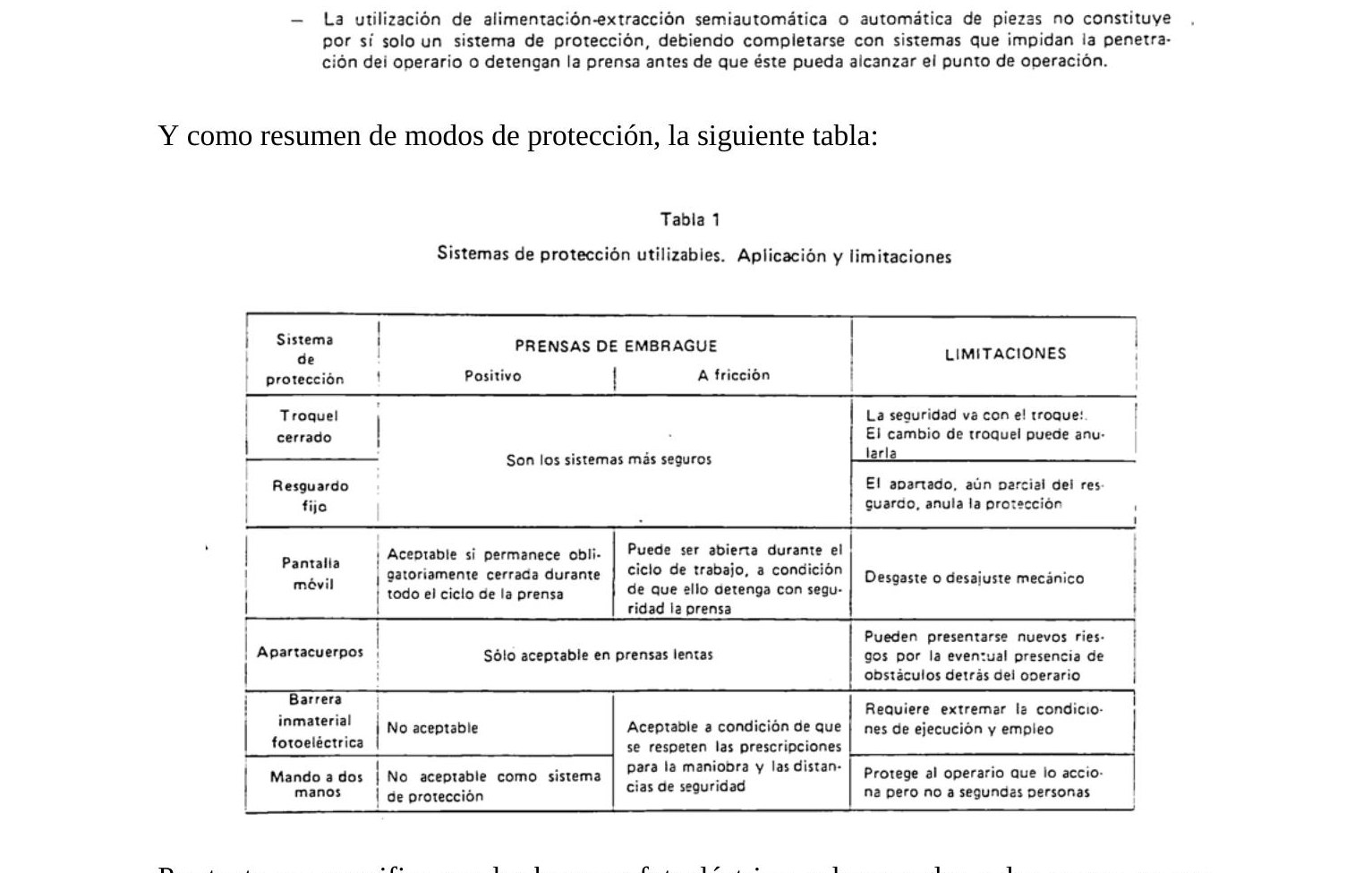
The position of photoelectric barriers and two-hand controls is thus clearly established. Further on, the standard itself explains why two-hand controls are not acceptable: they only work on machines that can stop at any point of their stroke, and that is not the case with positive-clutch presses. On friction clutch presses the situation is different: both the two-hand control and the light curtain are valid systems, but current regulations require them to be used in combination — not independently — since neither alone provides the required level of safety. The most common combination in industry is a two-hand control plus a light curtain operating simultaneously.
Additional requirements for movable guards on full-revolution presses
For presses that opt for movable guards — the most common system attempted — the standard adds very specific conditions:
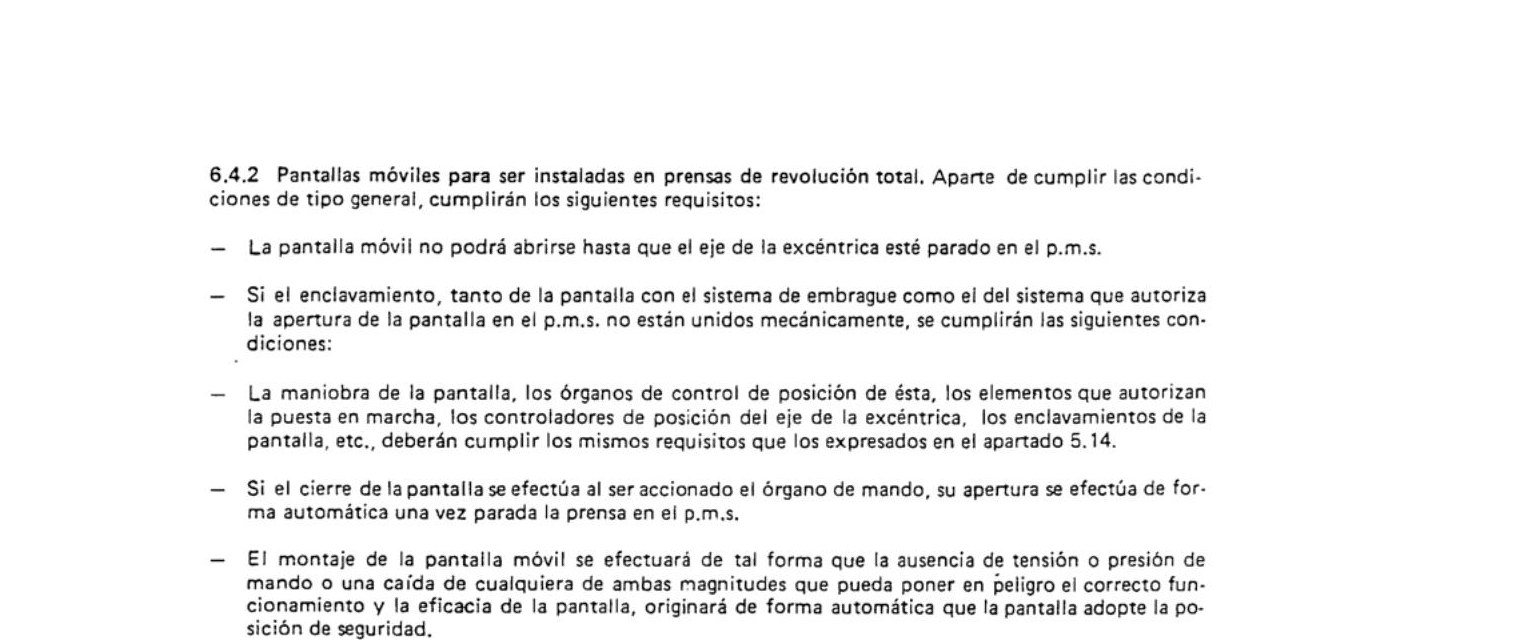
- The movable guard cannot open until the eccentric shaft is stopped at TDC.
- If the interlock between guard and clutch is not mechanical, the same requirements as in clause 5.14 of the standard must be met.
- Closing the guard on actuating the control must entail its automatic opening once the press has stopped at TDC.
- The guard's movement shall directly command the member that actuates the clutch.
We find ourselves, again, in the same case later covered by EN 692:1997: the guard must be mechanically fixed to the press latch, which is practically impossible on presses already built to traditional designs.
The requirement of a safe total stop (RD 1215/1997)
Beyond UNE 81-602:1986, RD 1215/1997 imposes its own minimum safety requirements. Among them, article 3 states:
How can a total stop "under safe conditions" be guaranteed on a mechanical clutch press? It really cannot be guaranteed in any case, because in the best scenario the press will only stop at the end of the stroke — not when any emergency stop is pressed. The only way for "safe conditions" to be maintained is for the guards to be fixed or locked until the slide has reached TDC and the flywheel's residual energy has dissipated, which brings us back to the same requirement already mentioned: full enclosure with electromagnetic locking.
The duty to carry out a risk assessment
Annex 1 of RD 1215/1997 specifies the obligation to carry out a risk assessment. The upgrade need not be identical to that of a new machine with CE marking, but it must be "sufficient" and "proportionate to the risks". These are broad concepts open to interpretation, but given the criminal and civil liabilities established in the Occupational Risk Prevention Act they must be understood in a demanding sense. The tendency of the Labour Inspectorate and the courts is to interpret them ever more strictly.
Once the risk assessment is done, the appropriate measures turn out to be practically the same as EN 692:1997 required for new machines: "the only real possibility is fully enclosed presses, with the working area closed, fixed or electromagnetically locked by guarding while any energy is present. In other words, machines exclusively for automatic work". Any other solution — magnetic tongs, two-hand controls, electro-pneumatic triggers — is clearly insufficient. The only alternative is the closed die, but this means guaranteeing that an open die is never fitted, which is impossible to ensure in practice — especially in companies with third-party or subcontracted dies.
Summary: valid and invalid guarding methods
The table below summarises which guarding methods are acceptable on a full-revolution mechanical clutch press, according to UNE 81-602:1986 and EN 692, and which are expressly excluded.
| Guarding system | Positive clutch (key) | Friction clutch (for comparison) | Note |
|---|---|---|---|
| Systems acceptable as the main guard | |||
| Closed die | ✓ Acceptable | ✓ Acceptable | Safety travels with the die. A die change can nullify it. |
| Fixed guard | ✓ Acceptable | ✓ Acceptable | Removing the guard nullifies the protection. |
| Movable guard mechanically interlocked to the latch | ⚠ Only if it stays closed throughout the cycle until TDC | ✓ Acceptable | On a positive clutch it cannot open until a full stop at TDC. |
| Systems NOT acceptable as guarding on a positive clutch | |||
| Two-hand control | ✗ Not acceptable | ⚠ Acceptable, but not as the only system | Only valid on machines that can stop at any point of the cycle. Current regulations require combining it with another system (usually a light curtain). |
| Photoelectric barrier / light curtain | ✗ Not acceptable | ⚠ Acceptable, but not as the only system | Ineffective if the machine cannot stop the slide on receiving the signal. Current regulations require combining it with another system (usually a two-hand control). |
| Sweep / pull-back device | ✗ Removed | ✗ Removed | Allowed under the old standard for ≤25 spm, banned by current occupational-risk law for causing its own injuries. |
| Magnetic tongs, pliers, magnets | ✗ Not as the only system | ✗ Not as the only system | A complementary measure, never a substitute for the main guard. |
| Electro-pneumatic triggers | ✗ Insufficient | ✗ Insufficient | Does not prevent access to the danger point during the cycle. |
| (*) Source: UNE 81-602:1986, EN 692:1996/2005, RD 1215/1997 and its official application guide. (**) Current regulations (UNE-EN ISO 16092-2:2021 and Regulation (EU) 2023/1230) require that friction-clutch presses with manual feeding always combine two safety systems simultaneously. The most common combination in practice is a two-hand control plus a light curtain. | |||
The real accident record: the most repeated accident and why it happens
To understand why these regulations matter, you have to grasp what kind of accident a mechanical clutch press specifically causes. We are not talking about the fatal accidents that can occur in large industrial installations. We are talking about the trapping of hands and fingers with severe crushing or amputation — a type of accident that does not kill the operator but permanently changes their life.
The typical accident profile
Mechanical clutch presses are usually small and medium machines — typically between 15 and 100 tonnes — intended for the cold stamping of small parts: gaskets, washers, thin-sheet components. Part feeding is manual: the operator places the part by hand, withdraws the hand, presses the pedal, the press strikes, and the operator removes the stamped part to start again. Hundreds of times per shift.
The accident occurs when the cycle is triggered with the operator's hand still in the die area. This can happen because of:
- Anti-repeat device failure: the press fires a second stroke without the operator pressing the pedal. This is the most frequent scenario on machines with this component worn or misadjusted.
- Inadvertent pedal actuation: the operator brushes it with their foot while manoeuvring, on a press whose pedal is not properly guarded.
- Distraction or automatism: the operator has spent hours repeating the same gesture and at some point fails to withdraw the hand in time. It happens more often than is acknowledged.
- Mechanical failure of the key: the key engages when it should not — through wear, dirt or a faulty spring — triggering a stroke at any point of the cycle.
The result is partial or total crushing of one or more fingers, often the whole hand if the die is larger. The injuries are usually irreversible.
There is a widespread belief that fitting a two-hand control to a mechanical clutch press makes it safe. This is a serious mistake. The two-hand control forces the operator to have both hands on the buttons at the moment of triggering — but as soon as they release one of them, if the press has already started the cycle, it cannot be stopped. If the operator releases the control before the slide reaches TDC (to remove a badly placed part, for example), they will be putting their hand in the danger zone while the slide is still moving. The standard says it without ambiguity: the two-hand control is not acceptable as a guarding system on positive-clutch presses.
What the INSST says: presses, the machine with the highest accident rate
The National Institute for Safety and Health at Work (INSST) is Spain's technical reference authority on occupational risk prevention. In its Technical Prevention Note NTP 256 — dedicated to guarding systems on vertical presses — the INSST states:
It is a sentence worth pausing on. It does not say the press is dangerous — it says it is the one with the highest accident rate, in frequency and severity, among all industrial machines. And that is said by the State's technical body.
In that same NTP 256, the INSST goes further in assessing the two-hand control — the system many companies believe legally protects them:
The INSST tool to assess your press
In 2021 the INSST published a specific app to assess the degree of compliance with RD 1215/1997 on eccentric mechanical presses predating 1995 — exactly the type of machines covered in this article. The app contains 125 questions covering the 19 provisions of Section I of Annex I of RD 1215/1997, and generates a deficiency report with corrective guidance.
A free tool from the National Institute for Safety and Health at Work to check compliance with RD 1215/1997 on eccentric mechanical presses predating 1995. Available for Android and iOS. Generates a downloadable deficiency report.
View the app on the INSST portalThe mere fact that the INSST considered it necessary to develop a specific 125-question tool to assess these machines — in 2021, decades after European regulations made them practically incompatible with manual feeding — speaks for itself about the scale of the problem in Spanish industry.
The employer's legal liability in the event of an accident
The first thing a user should do when they have one of these presses in their plant is to commission a risk assessment from a Senior Occupational Risk Prevention Technician. But there is something that must never be forgotten: that technician's interpretation is not final and does not exempt the employer from liability. The user is always ultimately responsible for the safety of their machines and their operators.
Many companies choose to commission the assessment from an OCA (Accredited Inspection Body), but do not always take two relevant matters into account. The first is that many OCAs do not have technical staff specialised in machinery classified as dangerous — that included in Annex IV of the Machinery Directive, among which are cold-working presses — and the quality of the report can vary considerably depending on the specific specialist who carries it out. The second is that OCA reports usually include caveats and liability limitations that protect the issuing body: in the event of an accident, the OCA does not assume the consequences. Ultimate liability remains, in any case, with the employer.
If an accident occurs, there are three avenues of liability:
Criminal liability: article 316 of the Criminal Code
This provision does not require an accident to have occurred: it is enough to establish that the worker is exposed to a serious danger. If the accident does happen, liability is aggravated. The tendency of the Spanish courts is to apply this article with ever more demanding criteria, and in most cases where an accident occurs on a mechanical clutch press with insufficient guarding, the employer's criminal liability is virtually taken for granted.
Administrative liability: inspection, withdrawal of authorisation and sealing
This is the most immediate consequence and the one most often overlooked. Administrative liability does not require any accident to have occurred: a labour inspector who visits the plant and finds a mechanical clutch press operating with manual feeding without the required guarding can act on the spot.
In practice, inspection action follows a common pattern. If there has been no accident, the inspector issues a requirement to halt or withdraw authorisation to use the machine until the deficiencies are corrected, together with the corresponding proposed financial penalty. If there has been an accident, the usual response is sealing the machine, which is taken out of service from that moment for the duration of the investigation — which can drag on for months.
The economic consequences of this route are often more immediate than the criminal or civil ones: the company loses a productive asset overnight, must bear the financial penalty — which in occupational risk prevention can reach, for very serious infringements, between 49,181 and 983,736 euros under article 40.2 of the LISOS (Royal Legislative Decree 5/2000 of 4 August), in its scale in force following the amendment introduced by Act 10/2021 — and has to face the cost of upgrading, retrofitting or replacing the machine within deadlines set by the Inspectorate, not by the company. All of this without prejudice to any other liabilities that may arise.
Civil liability
In addition to the criminal route, the employer is civilly liable for the damages caused to the injured worker — including consequential loss, moral damage and possible permanent after-effects. In the case of an amputation, the compensation awarded by the courts is usually very high. The employer may later pass on civil liability to the prevention service or to whoever carried out the risk assessment, but that does not relieve them of the initial obligation to pay.
Conclusion: what to do if you have a mechanical clutch press
The conclusion is the same for both new and existing machines: in theory these presses could be used, but only under very strict conditions — exclusively automatic work, a fully enclosed and electromechanically locked working area — which in most real uses are incompatible with production and normal operation.
Any use with manual part feeding under these conditions represents a very high legal risk for the employer and a real risk of serious, irreversible injury to the operator. The practical difficulty of the factory staff following those specifications day to day is a further factor that, in the event of an accident, aggravates the penalties and liabilities.
With more than 70 years of experience building mechanical presses, our position is clear: in the vast majority of cases, the safest and most economically rational solution is to replace or modernise the press. A retrofit with a pneumatic clutch radically transforms the machine's safety profile, allows two-hand controls and light curtains to be fitted with full effectiveness, and can mean a saving of 50–70% versus an equivalent new press.
That said, we must be realistic: converting a mechanical clutch press to pneumatic is not always cost-effective, especially on old, low-tonnage machines where the cost of the conversion can approach that of the machine itself. In those cases we have a very practical alternative: repaired and reconditioned second-hand presses, overhauled in all their critical components, with the regulatory upgrade already carried out and documented. It is a solution that replaces the problem machine with an equivalent one that complies from day one, at a cost far below that of a new press. In no case do we recommend continuing to operate with manual feeding on a mechanical clutch press without a prior technical assessment and the implementation of measures that go beyond a two-hand control or a light curtain.
* Reference is made to EN 692 because it was the first standard approved for the certification of mechanical presses at European level, and it is still cited in its early versions. The harmonised technical standard currently in force is UNE-EN ISO 16092-2:2021.
Frequently asked questions about mechanical clutch presses
They are not expressly banned, but since the 2005 revision of EN 692 removed every reference to them, there is no presumption of conformity for building new full-revolution clutch presses. Existing ones must comply with RD 1215/1997, but the required conditions are so restrictive that in practice they can only run in automatic mode with the working area fully enclosed and electromechanically locked. Any other use carries a very high legal risk for the employer.
No. Neither UNE 81-602:1986 nor EN 692 accepts the two-hand control as a guarding system on full-revolution clutch presses. The reason is technical: the two-hand control is only effective on machines that can stop at any point of their stroke. On a positive-clutch press, once the cycle is triggered it cannot be stopped until the slide reaches top dead centre. The INSST itself warns of this in its NTP 256, calling it an error to recommend the two-hand control as if it were the universal solution.
No. Light curtains are not acceptable on positive-clutch presses either. If the barrier is broken during the cycle, the press cannot stop the slide until the stroke ends. UNE 81-602:1986 expressly rates them as "not acceptable" for this type of clutch.
The only acceptable methods are: (1) a closed die, which by design prevents access to the danger zone; (2) fixed guards blocking access from every side; and (3) movable guards mechanically interlocked to the clutch latch, so the guard cannot open while the slide has not reached TDC. The sweep/pull-back device, formerly allowed for slow presses below 25 spm, is no longer permitted under current occupational-risk regulation, as it causes its own injuries.
The most characteristic accident is the trapping of fingers or the whole hand at the point of operation, with severe crushing or partial or total amputation. These are generally not fatal — they are small presses for small parts with manual feeding — but they cause permanent, irreversible injuries. The INSST rates mechanical presses as possibly "the machine with the highest accident rate, in both frequency and severity" (NTP 256). The accident occurs when the cycle is triggered with the operator's hand in the die area, through anti-repeat failure, inadvertent pedal actuation, distraction or mechanical failure of the key.
The employer bears ultimate civil and criminal liability. If an accident occurs on a press with insufficient guarding, article 316 of the Criminal Code applies, with prison terms of 6 months to 3 years for anyone who, being legally obliged, fails to provide the necessary means for workers to carry out their activity with adequate safety measures. This is independent of whether a risk assessment was commissioned: the prevention service gives its technical opinion, but legal liability always rests with the employer.
Do you have a mechanical clutch press in your plant?
We have spent more than 70 years building and modernising presses in Spain. We assess your specific situation and tell you exactly what options you have, with no obligation.
Related articles
Applying RD 1215/97: what it requires and the liability of non-compliance
What elements must be installed, and the criminal and civil consequences of not applying it.
Read article
Press retrofitting: when it makes sense versus buying new
A pneumatic-clutch retrofit can mean a 50–70% saving and resolves the safety problems of key clutch presses at the root.
Read article
Mechanical press maintenance: importance and correct application
The critical inspection points, how often to check them and the consequences of neglect.
Read article